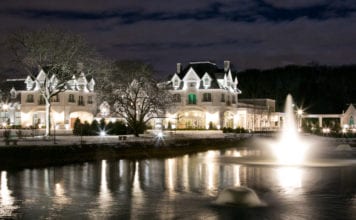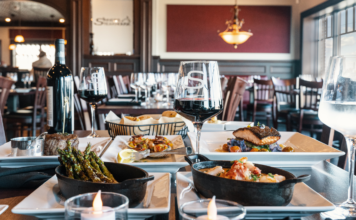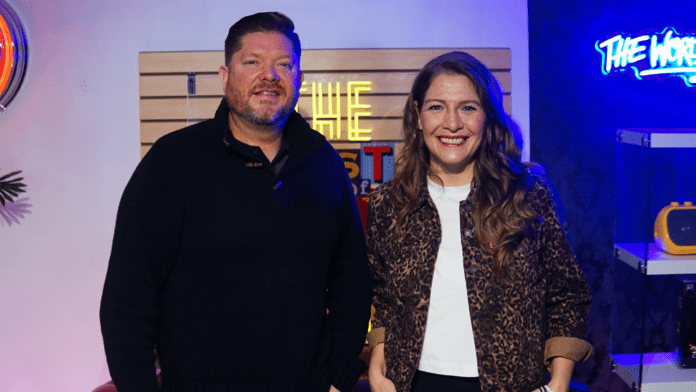
On this Episode of The Best of New Jersey Podcast, Amanda catches up with Chef Jamie Knott, the Restaurateur behind Saddle River Inn and Saddle River Cafe, plus Madame and Cellar 335 (Jersey City). Learn about how he developed his culinary skills, lessons learned as a restaurant owner, his favorite places in the world to eat, and what’s on the horizon.
Watch The Full Episode Now
Learn More About Chef Jamie Knott
- Follow Chef Jamie on Instagram: https://www.instagram.com/knott.jamie/
- Follow Saddle River Inn on Instagram: https://www.instagram.com/saddleriverinn/
- Check Out his new Clothing Line: https://www.instagram.com/wearsundaysauce/
For More from The Best of New Jersey Podcast:
– Follow Amanda on Social Media @DontSitHome
- Instagram: https://instagram.com/dontsithome
- YouTube: https://www.youtube.com/@DontSitHome
- TikTok: https://www.tiktok.com/@dontsithome
– Follow Best of New Jersey @BestofNJ
- Website: https://bestofnj.com/
- Instagram: https://instagram.com/bestofnj
- Facebook: https://www.facebook.com/bestofnj
- YouTube: http://www.youtube.com/@bestofnewjersey
- TikTok: https://www.tiktok.com/@bestofnj.com
– Follow the Podcast @bestofnjpodcast
- Instagram: https://www.instagram.com/bestofnjpodcast/
- TikTok: https://www.tiktok.com/@bestofnjpodcast
Intro Music: Safety Net – Riot (https://www.youtube.com/watch?v=faEtFGEqEAo)
The Best of New Jersey Podcast Synopsis:
The Best of New Jersey Podcast is a dynamic podcast that celebrates the deep-rooted connection between New Jersey’s most influential figures and the communities that shaped them. Each episode features engaging conversations with high-profile celebrities, executives, athletes, and entertainers who have lived, worked, or continue to be a part of the Garden State. Through personal stories, nostalgic reflections, and shout-outs to their favorite local businesses—from beloved coffee shops to iconic pizzerias—we explore what makes New Jersey truly special.
More than just a storytelling platform, The Best of New Jersey Podcast is a tribute to the state’s vibrant culture and thriving business scene, spotlighting the places and experiences that have left a lasting impact on those who call New Jersey home. Whether you’re a proud Jersey native or just curious about what makes this state so unique, our podcast offers an entertaining and insightful look at the personalities and businesses that define the heart of New Jersey.
Click to Read Full Transcript
Amanda Morrison: Welcome to the Best of New Jersey podcast presented by best of NJ.com. The podcast that celebrates New Jersey’s most influential figures and the communities that shape them. Big names, real talk, real Jersey. I’m your host, Amanda Morrison, the influencer behind Don’t Sit Home.
I want to welcome today’s guest, chef and restaurateur, Jamie Knott. Welcome to the Best of New Jersey podcast.
Jamie Knott: Thanks so much for having me. It’s a pleasure to be here.
Amanda Morrison: So, let’s go right into it. You have four restaurants right now in New Jersey. Where are those?
Jamie Knott: Uh, there’s two in Saddle River and two in Jersey City. I’m going to go in chronological order, I guess, because that’s the way my mind works. But Saddle River Inn is my baby. Um, we opened 13 years ago, which is hard to believe. We’re on year 14 of business, I guess we could put it that way. Then we moved down to Jersey City. We have Cellar 335, uh, which is an Asian tiki bar, but for the month of December, it’s Sleighs and Leis. It becomes a Christmas pop-up, a Christmas throw-up in the best way possible, people have said. Uh, then we go back up to Saddle River. We have the Saddle River Cafe, which is uh, seven years. I just I don’t know where the time goes.
And then we go back downtown, back down to Jersey City. Right behind Cellar is Madame. So we’re on our fourth year of operation.
Amanda Morrison: Okay. So, were you, I think I read that you’re from Baltimore, but you grew up in New Jersey.
Jamie Knott: That’s correct. Um, from Baltimore, Maryland. I moved up here when I was 10 years old. Uh, really quickly, my mom owned a bar. Um, she met my stepfather there. He was in dental school in Maryland and he bartended there on the weekends. They fell in love. Uh, he graduated, proposed. His family’s from this area. His dad had a dental practice in Belleville. So, we moved back up here to the lovely town of Nutley.
Amanda Morrison: Okay. So, do you growing up, did you always know you wanted to be, were you always in the restaurant business? Did you just love food? Did you, you know, how did, how did this whole path start?
Jamie Knott: Growing up, all I knew is I was always in trouble or punished or in time out or some version thereof. So, I had a lot of energy to say the least. That’s how I like to remember it. That’s how I like to tell my side of the story. Um, and I just knew I wasn’t meant for like an office job or a nine to five, something like that. I needed something else, something different. And my first job was a bus boy in Nutley at the Franklin Steakhouse, the original iteration. Um, and it was kind of love at first bite. You know, that’s my dad joke of the day for those of you paying attention out there. But, uh, basically, you know, the camaraderie, the action, um, the adrenaline rush, you know, getting ready for dinner service. It really, everything kind of jived with my personality and I, you know, I really did fall in love with it right away. So, I went from bus boy to food runner to barback. You know, just kind of worked around and then I hung out in the kitchen more, you know, when the owner wasn’t there. I think I was 15 and he was never there on Sundays. So, I used to I started making salads and then my parents both worked nights. So, I would watch the Food Network on my days off or and cook for myself. It started kind of slow, you know, sandwiches and then it would move to like eggs, big egg guy, all kinds of omelets. So, um, but that’s really how I learned, you know, was, I hate to say it, but watching TV. Yeah. You know, I was a sucker for the Food Network.
Amanda Morrison:What do you think was your first kind of breakthrough? I mean, was it an omelet? Like, what was your first favorite dish that you’ve ever made that you’re like, “I actually really can do this”?
Jamie Knott: That’s so funny. Nobody’s ever asked me that question. Uh, and it’s such a great question. I’d have to think about it a little bit. I’m not 100% sure. I remember, Oh, um, my parents had a beach house in Ocean City, Maryland, big seafood town. So, I made these uh kind of garlic tomato crab pasta when I was maybe 17 or 18. And I was like, “Wow, I’m getting pretty good at this”. You know, cuz everybody else reacted.
For me, it was always like, “It needs this, it needs that, it needs this”. You know, I have the artist curse where I’m kind of my own worst enemy. But, um, based on everybody’s reaction at the table, I that’s that’s a memory for sure.
Amanda Morrison: Did you have a favorite salad? Salad? You said you started making salads. So, did you have a-
Jamie Knott: Oh, salads. Well, yeah. I mean, the steakhouse salad was amazing. Um, it was basically chopped romaine, roasted peppers, uh, baby mozzarella, and, um, sliced fillet with like this honey balsamic. That was at the steakhouse. So, when I said I was making salads, I was making their salads, not my salad.
Amanda Morrison: You can always put your own touch on something. So, then, okay. So, you started, you had bus boy and you worked way up there. Um, what do you think? Was there a specific job or partnership that you kind of got your big break that you that took you to the next level?
Jamie Knott: I I’m not sure if this was a big break, but I when I left the steakhouse, I went to work at this um Irish pub in town called um Scuttlebutts. Um, and there was a guy by the name of Michael Fitzsimmons. He was a partner there. Uh, one of the sons. It was a family-run restaurant: mother, father, and two brothers. Um, and I was a bus boy there supposedly, but I was always in the kitchen. And at this point, he’s like, “If you’re going to be in the effing kitchen, you’re gonna work in the effing kitchen”. So, he really kind of taught me my chops, you know, how to make like chicken roulade, which was awesome. It was like their standout dish. Basically, it’s a pounded chicken breast and you can stuff it and roll it with whatever you like, um, mashed potatoes, like veal stock, things from from scratch, you know. And that was uh, it’s a memory that’s kind of etched into into my head. I remember this one thing. It’s very small, but it’s it’s so true. Excuse me. Um, he’s like, “Mix the mashed potatoes, put them on the plate”. So, I go in and I just kind of turn them over a little bit once. He’s like, “That’s not mixing mashed potatoes”. I don’t know if we can curse on this show, but I, you know, I’m a kitchen pirate. I curse. It happens. It shows emphasis and passion. Uh, he’s like, “This is how you mix potatoes”. But you know, those kinds of things stick with you. Um, and then I had another much more impactful kind of mentor, uh, as I got older and I was in culinary school. I went to school in the city, New York restaurant school, uh, guy by the name of Frank Delatrin. He was French but grew up in Italy and he spoke four languages and he was the hardest guy in the world to understand and he would just scream at me in a microphone. It was a big open kitchen in the city, a place called Café Centro. They had about 300 seats, a bustling restaurant, but I just remember him on me all the time and that, you know, it paid dividends in the future. I cried probably twice a week at that point, but I didn’t realize how impactful he was until I left the company and went on to do other things.
Amanda Morrison: Okay. So-
Jamie Knott: I still think of him to this day.
Amanda Morrison: What were, so, what were some of your other things before you had these four restaurants?
Jamie Knott: Um, I worked for Restaurant Associates. I got bounced around a little bit there. Um, I was late every day. I was coming from school downtown. So, I’m at the mercy of the subway and tra, you know, walking street traffic. And I worked the amuse station. Basically, I would make one bite for each guest that comes in for dinner and then that turned into the oyster station. So, I would have very limited time to make 200 of something out of nothing. It was basically go utilize things that we don’t really use, if that makes sense. If there’s scraps from short ribs or extra rice from risotto or, you know, saffron, whatever it is, figure it out and bring me something by 4:00 every day. This way, I would have an hour cuz service started at five if he needed to tweak or change or fix. Um, and that that lesson was invaluable. I would get there at like 3:15. So, I had 45 minutes, you know, to come up with a dish every day based on what’s in the walk-in. Eventually over time, I got a little bit smarter and I would plan it the week out or when I knew we had a special each day. It’s a very French thing, you know, like roast of the day or fish of the day or whatever it is. So, I knew what was going to be left over by by that point. So, I started developing a little bit of a schedule and, you know, coming into my own and and thinking forward and what’s next and how to utilize product. And that, I mean, today it’s it’s the most important thing when you get a secondary or tertiary tertiary use out of a piece of protein or, you know, uh a grain or a fish. It’s that’s how you make money in the restaurant business. It can’t just be protein on a plate anymore and charge what you have to. You’d have to charge $100 for everything. Food is just so expensive now.
Amanda Morrison: So, what do you think actually was probably one of the bigger moments that just kind of pushed you into a style cuisine or do you even have, do you feel like you fall under one category or do you think you have multiple?
Jamie Knott: That’s interesting. I’m going to say it developed over time because, you know, from I went from French restaurants to steakhouses to big box, you know, quasi Chinese. Like, I was the chef at China Grill. That wasn’t Chinese food per se, right, but it had Asian flavors and flavors of Asia and a different way to think and and look at food and different ingredients. And it’s the first time I used coconut milk and curry and galangal and, you know, uh cilantro root, just things in a different way. And I guess over time I’ve I’ve found my my kind of niche. I mean, I personally, I like French style cooking with Asian flavors and it it seems to work. You know, people seem to like it, I guess.
Amanda Morrison: Did you, did you ever do any traveling to get some inspiration also? So, obviously, there’s a great food scene in New Jersey and New York, but there is a lot more out there in the world.
Jamie Knott: There is a lot more out there. And I, you know, I make a joke, I eat out 375 days a year, you know, cuz some days if I’m not eating at a at a restaurant for dinner, I’m there for lunch and dinner, or, you know, just always out looking and and seeing what’s out there. Most of my traveling for food came probably at the end of last year and the beginning of this year. Uh, you know, it’s hard to travel when you’re young building a business and you have young kids. You know, how and when can you get away? And before, you know, we had our first kid at 25, 26. We were both turning 26. So, it was it was a challenge to to travel to culinary destinations both monetarily and, you know, timewise. It was it was tough. So long long answer longer. Not much international travel to find my style. I guess it was more localized and and great restaurants.
Amanda Morrison: Well, now that you can travel more, what are some of your favorite destinations for inspiration?
Jamie Knott: I had a I had a solid year. Um, we went to Raiki, Iceland. Uh, we went to Copenhagen, Denmark. We went to Salzburg, Austria, Geneva, Switzerland. Uh, Paris, Barcelona, Ibiza. It was it was it was a solid year. Um, Paris, I found the food simple, much much more simple than I thought it would be. Um, but I guess that’s kind of how I cut my teeth and the food I came up on. So, you know, it was what I’m used to, I would say. You know, and simple to me is probably not simple to everybody else. Um, I enjoyed Copenhagen a lot. Their food scene’s pretty amazing. Um, I don’t want to get the statistic wrong, but I think they touch more water than any other country or city on on on the earth. It’s And they live by uh by river. Yeah. And it’s really, it’s just a cool place. Um, everything’s based on that, you know. So, that was that was nice to see and it was interesting. And they travel by bike. Everybody’s, you know, just in great shape. They’re all six foot, blonde, blue-eyed, you know, with perfect bodies. It’s an interesting place. It can make you feel good and bad about yourself.
Amanda Morrison: I can see that. Yeah. So, even through, you know, growing up in New Jersey, your whole path in going to school in New York, what also made you decide you wanted to open restaurants in New York and not or in New Jersey and not in New York?
Jamie Knott: I don’t know. I think after spending 14 years in the city and living my life by a bus schedule, you know, subconsciously something just just told me to look in New Jersey. And I did. You know, I was at the time I was at uh Artisal, which was, you know, a huge French restaurant on 32nd in Park. At the time, I was I started working with a uh restaurant broker and I probably looked at, you know, 60 places over the course of three or four years. And um I just I, you know, I knew I wanted to be close to my family and close to home, I guess, is the is the easiest answer.
Amanda Morrison: Okay. So, what made you decide on your first spot?
Jamie Knott: God, um, fate. Um, as soon as I, so, basically, uh, we had a meeting on like a Wednesday afternoon at at 1:00. So, I I ended up being early, which was the first time in my life I think I’ve ever been early. But, we and I prove that today. We were d I started driving around Saddle River, you know, cuz I’m from what, 14 miles south of that. I had no idea a town like that existed. I mean, it’s, you know, I describe it as Beverly Hills in New Jersey, but you go up and see these homes and these sprawling estates. I’m like, this this is the right town. People tell you location, location, location, right? So, I knew the location was right. And then I fell in love with the with the barn as soon as I walked in. I mean, it’s just it just has so much natural charm and character that uh, you know, again, love at first sight. I really just I I really just felt it. Um, and and the price was kind of right. You know, they were uh, family Hans and Alda Egg. They were there for since 1981 and I bought it in 2013. So, um, what’s uh 20, 34 years and they were the first kind of doing that. They they brought real fine dining to a quiet suburb of New Jersey. You know, there’s a lot to be said for that, but it was the charm and the character that that really just sold me.
Amanda Morrison: Do you have any specific highlights for each restaurant that you’re happy that maybe even or challenges you overcame or just certain things you’re just overly proud of?
Jamie Knott: Yeah, for for Saddle River Inn, um, we got an excellent in the New York Times and it was kind of the moment I felt like I had arrived in the culinary industry. I remember it like it was five minutes ago. Um, I was on the phone with a regular guest and she was in Florida. It was a Saturday and it was in the Sunday Times. That’s where Jersey restaurants used to get reviewed. And I was driving to work and she called me and she’s like, “Did you see it?” And I said, “See what?” She’s like, “The review? It’s in the Times.” She’s like, “We’re subscribers. Here’s my address. Go grab it out of the mailbox and read it”. So, I drove up to her house. I sat on the curb and I read it and I cried for probably 20, 30 minutes. Um, you know, it was it was the biggest accomplishment of my life, of my career, non-personal related. And, you know, those words changed my life. I mean, we went from whatever 35 covers on a Wednesday to 120 covers every day of the week for almost two years. I mean, it was just it was life-changing. It was life-altering for everybody that was in that restaurant.
And just the way she wrote it, it was just it was really smart and and and it, I have to read it again actually. I got to remind, I got to remind myself sometimes. Um, and then the cafe. Uh, the cafe’s an interesting place. It’s it’s had many lives in its short lifespan. We’ve changed the concept slightly, probably three times. Um, in the beginning it was like I was on a health kick when we first opened. So, I wanted like a juice bar and I was afraid of taking business from myself cuz it’s literally the restaurants are 100 yards apart. So, I wanted something totally different. So, it was breakfast and lunch only in the beginning and then we morphed into kind of an all day brunch and then brunch and dinner. So, now it’s a brunch and dinner restaurant. We redid the inside. We put a beautiful patio outside that’s four seasons. It’s fully enclosed right now. Um, so that’s, you know, they’re they’re all they’re all their own children and they grow in their own way. You know, you kind of just want them to be good good people in this in this case, but good restaurants, you know. Um, and then moving down to JC, I think the first time we got on the uh top, it was the top 25 at the time. Um, it meant a lot because, you know, it showed me that I can do a different style cuisine and have have fun with it. Jersey City was a real challenge in the beginning. I mean, you you’ve seen the you’ve seen the change in Jersey City. I mean, 10 years ago, it was just a totally different place, especially where we are.
Amanda Morrison: Oh, yeah.
Jamie Knott: You know, the income level, everything was just different. So, our guests have changed over time as well. And it’s a transient city, right? So, of course, it’s naturally going to change on its own. But um I I’d like to think that we we made a little neighborhood over there. You know, now there’s other restaurants and more restaurants coming and there’s 25 new buildings in the area. So, um, and the same with Madame, I’ll say, you know, year one, we we were on the top, top 25 in New Jersey. So, um, it just it’s it’s good for the team, it’s good for the crew, it’s good for the restaurant. I always look at them as their own like living breathing thing. You have to treat it and feed it and take care of it and love it and it’ll grow. And that’s kind of, you know, the philosophy I guess we stand by.
Amanda Morrison: So, we were talking, we were talking about how, you know, a restaurant had many different lives. How much or have you seen a shift in the restaurant industry in New Jersey in general or certain trends that have happened either in the past or that you’re predicting in the future and how much do you let that impact kind of the changes you made? I mean, you said you were on a health kick and you you wanted a juice bar, but that was you were you were influencing yourself. How much you let outside trends influence the directions you take your restaurants?
Jamie Knott: I mean, that’s a, there’s so many answers for that question, but I think the restaurant business first and foremost has changed uh, post-COVID, right? The amount that people want to work, the hours of operation, how much people go out? You know, the first year after COVID, it was a free-for-all. You know, you could print money in the basement. You know, it was easy. I hate to put it that way, but that’s how it felt. And then the second year when everybody ran out of money, it became impossible. And now we’re kind of just barely working our way out of that as we hit the third quarter in 25. And it’s been, has it been six years, seven years? I mean, it’s it’s crazy, but we’re still feeling the effects from that. Um, secondly, the cost of goods. You know, I always use this as an example. I’ve had skirt steak on the menu probably since inception at the Inn and it was $5.99 a pound, prime skirt steak 13 years ago. Now it’s $25.99 a pound. So, one item has gone out gone up $20 a pound. You know, dairy, cream, butter, all of it, 30, 40, 200%. Olive oil’s gone up 400%. I mean, it’s it’s crazy. The world’s a the world’s a crazy place now. Um, as far as outside trends, you know, I like to I like to dine out and I eat out in the city probably one or two days a week. I want to see, I want to see what’s going on at the best restaurants. It’s funny now all the new restaurants are smaller. This is the trend right now. You know, Corner Store and The 86 are perfect. They’re owned by the same people. Uh, uh, Eugene Rem owns the the group, but they’re like smaller places, super hard to get into and very kind of simple food. You know, who has the best Caesar salad, the best burger, the best French dip? That’s what everybody’s going for. They’re all kind of fighting over the same pie, and I find that very interesting. But they’re they’re packed. You can’t get into them. And you’re getting, you know, $58 for a French dip sandwich, it can’t hurt the food cost.
Amanda Morrison: You know, with your first restaurant, did you have any challenges kind of that um, you know, you talked about a little bit of some struggles, but was there ever a moment where like, “I don’t want another restaurant. One is good enough for me” or-
Jamie Knott: One moment? I I wish there was one moment. I mean, the first three years were a huge struggle and challenge. Um, I separated with my with my business partner. Uh, we didn’t pay payroll taxes for 19 months. I had to borrow $74,000 from my accountant and we used to close, we still do. We close 10 days in the winter and 10 days in the summer and we pay everybody, which is almost impossible to do especially for a new business. I remember being uh in Cape May on 4th of July or 5th of July and the bank account was overdrawn. You know, I I called my dad. I said, “Can you transfer money in? You know, we’re short. It’s going to hit”. I didn’t realize how the credit cards hit and how long it take. You know, so, uh, I’m like, “The credit cards are going to hit tomorrow.” I’m sorry. Um, and my dad was my principal financer, you know. He was he was my business partner. He he he wrote me a check and and off we went. Um, some people look back now and they’re like, “It’s, you know, you got that thing for a steal.” Everybody likes to think they got a deal, but I bought the Saddle River Inn for $328,000 and, you know, they held 150 of it on paper, which was without that and owner financing in that way, there’s no shot I ever would have had a chance to even be in the rest, in my own restaurant. You know, my dad took a chance on me because he saw the passion, the dedication and my parents came to every restaurant that I worked at. They were proud. They still are, I hope. You know, I’ve done some things that they’re not that proud of, but in the restaurant business I’d like to think I’ve done some things that they are proud of. So, challenges on a daily basis. I can’t do this weekly. You know, payroll comes every week. You got to figure it out. You know, you got to you got to fund it. You got to pay people otherwise they stop showing up. You know, and I I remember being, I remember sitting in pre-shift every day like, “Guys, we’re going to do a 100 covers a day. We’re going to do a 100 covers a day”. I like, like maniacal talked myself into it and then it happened, you know, and off we went. And it’s kind of never changed. It might be harder now to get a reservation than it was eight years ago, even after the review. So, thank God.
Amanda Morrison: Do you have any um, you have a piece of like any advice you would give to someone who wants to go into the restaurant business? Like a lesson learned and a piece of advice?
Jamie Knott: I would say a few. Um, don’t forget where you come from. Keep your head down. Make the food first. And, you know, treat people like they belong. I remember coming up in the industry. It was a lot different. I had sous chefs that would, you know, break my tongs and throw them in the garbage on a daily basis. Like, “This is not a tool that belongs in the kitchen”. They wanted you to use spoons in old classic French kitchens. You know, even doing 300 covers, you can’t flip a piece of fish with, you know, with tongs. Um, so be kind to people. Sounds silly. Treat them the way you want to be treated. Be respectful and lead from the front. You know, and and believe in yourself to the point of borderline insanity. You know, you have to you have to really really force yourself mentally to to come outside of yourself sometimes and trick your own brain, you know, if that if that’s if that makes any sense at all. But um, you know, there were days I would get there at 9:30 and leave at 3:30 in the morning cuz, yeah, to make every butter and puree and and cut all the meat and fish and there’s never enough time in the day. So, be organized, um, be prepared to lose a lot to the point that you have to enjoy losing and believe in yourself more than anybody else. Those are my I guess three foundational points.
Amanda Morrison: Okay. So, you have your four restaurants. What is next? Do you, I mean, do you have any other projects going on? Are you opening up any restaurants? Do you hope to open up any restaurants or-
Jamie Knott: Yes. Um, short answer, yes. Uh, as far as restaurants are concerned, it’s it’s a challenging time and it’s a challenging business and to find the right thing, it almost takes five projects that never come to life. Believe it or not, uh, to get four, we probably looked at 10 or more. Um, so, uh, it just it has to be the right time and place. And, um, at this point I really am not into signing leases. I, you know, I’m getting older. I I need like an exit strategy. I would like to own real estate and and move into that direction. But something that is on the horizon is um, our clothing brand, Sunday Sauce. Uh, pre-sale is going to start. I don’t know when this is going to air, but you know, right around Christmas. Okay. So, we’re in production right now. Um, to our dismay, we’re going to start as a hat company, but you know, Amazon was a was a book company, right? So, we have to start somewhere.
Amanda Morrison: Everyone, everyone has a head, so you’re good. Do have any like a certain kind of menu or a limited edition or do you have anything special that you do at any of your other restaurants?
Jamie Knott: Sure. I mean, I think that’s an opportunity for each chef to shine in their own individual way. You know, it’s it’s one thing to hand somebody a recipe and say, “Cook my food”. It’s another thing to, you know, have some camaraderie and make them feel part of, you know, at that point they’ll take ownership. So, um, specials are are super important and seasonality is, it’s, I’m not going to say it’s simple, but it’s what’s around us and what’s in the market. Fortunately or unfortunately, now people have to think a lot less because you can get anything you want any day of the year. You know, there’s the se, it’s almost like there’s no seasons anymore based on shipping and ordering. You can get whatever you want. But um, we make seasonal changes probably three times a year and the core menus stay the same and then we do seasonal specials, you know, weekly.
Amanda Morrison: So, was there one dish that you were trying to put the concept together that you weren’t sure it would be a favorite for um, your your customers? I mean, was it, you know, some people take a risk and it can go in two very different directions?
Jamie Knott: Um, yeah. One dish that comes to mind is the tuna carpaccio at Saddle River. And it’s kind of uh a deconstructed tartar, if you will. I was sick of seeing the same thing. Everybody has a tuna tartar with avocado and cucumber and sesame vinaigrette. I’m just throwing that out there. But what, what I kind of wanted to do was was create like a palette. So, I looked at the plate, you know, as a frame and we pounded out tuna to the shape of the plate and then we put all the ingredients kind of splattered across it like like a painting. It looks like a like Jackson Pollock a bit. Um, you know, and it sounds simple in essence, but at the time raw food wasn’t everybody’s favorite. Um, but now it’s a signature dish. It’s had five iterations. Okay. Um, because we used to use a ring mold and cut it in a perfect circle, you know, and that takes time. And I’ve probably lost three cooks over that dish. I’m serious. It sounds crazy, but I had to move away from it for a little bit because I couldn’t keep somebody on that station because they didn’t want to do it. It was either before service or after service. And it takes probably a solid hour to make 15 of them, which, you know, is what we sold them. We probably sell 22 of them a day. So, um, you know, there’s a there’s a love-hate relationship there, but it’s been featured a bunch. It’s it’s just such a great dish. Um, I’m I turned it into a tartar probably eight years after being there. And I had a lot of push back. You know, regular guests would call and request the carpaccio. And it’s like, “It’s the same exact thing. We literally put the same food. We just cut it differently and put it in a mold.” “It doesn’t taste the same. It’s not the same.” You’re right. Um, but we say yes to pretty much everything. Uh, that’s that’s kind of our philosophy. If we have it, we’re going to do it. You know, we came to cook and you came to eat. I keep it really black and white and really simple. And that thought process has evolved. Also, when I first got, you know, when I first opened the restaurant, I was like, “I’m the chef and this is what we’re doing and this is how you’re going to eat it”. And then you have a kid and another kid and you look at your bills and you’re like, “Absolutely, whatever you’d like. You guys came here to eat. I came here to cook. This is simple. What a beautiful synergy”. You know-
Amanda Morrison: Do you have anything in the works that you can give us the exclusive on that you’re kind of experimenting with?
Jamie Knott: I want to recreate beef Wellington. I, I don’t know exactly how to do it. Um, we had a Chaîne des Rôtisseurs dinner last Sunday. That’s a wine club that started in 1219 in France. We do their annual uh, Christmas party, if you will, or end of the year party. And I did a venison beef Wellington, but I kind of did it, you know, puff pastry, mushroom duxelles, foie gras mousse, and then I was messing around with like a cream spinach vinaigrette. But um, that’s something I’m I really want to nail because it’s it’s a beautiful classic and I think it deserves some respect and and time in the sun.
Amanda Morrison: I want to thank you for being here. How can everyone follow you?
Jamie Knott: Uh, Knott.Jamie on Instagram and everything’s up on the link tree there. You’ll see all the restaurants and all their IG handles. I think that’s the easiest place to find me. But um, congrats on the podcast. I’ve known you for a long time and this studio brings back memories. We we filmed our podcast here so I felt right at home. And I appreciate you for having me. So, thank you.
Amanda Morrison: Thank you for listening. Make sure you check us out wherever you listen to your favorite podcast and follow us at Don’t Sit Home and the Best of NJ podcast on social media.
Watch The Latest Episode of The Best of New Jersey Podcast!
Top Photo: © BestofNJ.com