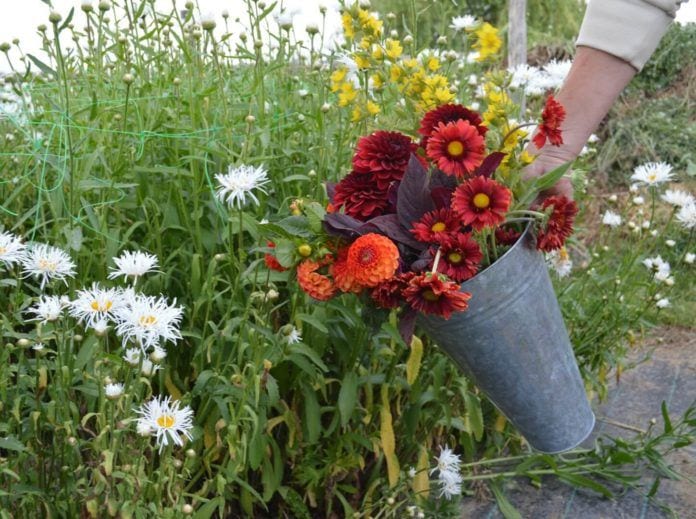
Nothing says spring quite like a beautiful bouquet of freshly-picked flowers. Whether we’re picking blooms from our own backyard or relying on supermarket finds to brighten up our living space, the bouquets never seem to be on par with those of the experts. We enlisted the help of Tonya Lee, a florist, artist and professor at Monmouth University who sells her extraordinary spring bouquets at Red Moon in Asbury Park, to ensure our once droopy bouquets are destined to stun.
Even though we may love the idea of florist-created centerpieces in our homes at all times, most of us can’t afford the weekly expense. While we may leave the larger arrangements to the professionals, there’s no reason why we can’t enjoy fresh flowers in our homes all season long. All you need is some practice, a sharp blade or shears and access to flowers.
 “I’m a big believer in anything goes,” says Lee. “If you like the way something in the garden looks, try it as a complement to a bouquet you’ve already purchased.” For spring in New Jersey, Lee supplements early spring flowers such as peonies, hellebore and ranunculus with blooming branches and bulb flowers found in her backyard such as lilac, cherry, viburnum, dogwood and muscari.
Whether you’re looking to freshen up a store-bought bouquet or attempting to create a piece of spring art with your own backyard blooms, Lee recommends picking out the bouquet’s vessel first, then finding one type of flower to center your bouquet around. Once you’ve chosen the main flower, you can use analogous and complementary colors to round out the bouquet’s palette.
 “I start with the vessel, then choose stems that complement the shape of that vessel,” says Lee, who uses an elongated vase to showcase tulips and calla lilies and a gourd-shaped vase to display peonies and dahlias. After you’ve picked out your vase, there are three components to consider when creating a stunning spring arrangement: filler, spiller and thriller. The filler creates the overall shape, the thriller adds the wow factor, and the spiller creates asymmetry.
Another aspect of a bouquet that may also be one of its most important traits is its freshness. To ensure spring bouquets will continue to shine throughout the week, Lee inspects the stems for firmness and the leaves and petals for brown spots. To keep spring blooms from wilting, Lee recommends:
- Cutting the stems on an angle with a clean blade or shears, which allows the flowers to drink and rehydrate.
- Removing any leaves that sit below the water line to avoid rot and bacteria growth.
- Changing the water every few days to prevent rot stemming from bacteria in the water.
- Keeping the arrangement out of direct sunlight and heat.
- Washing the container thoroughly with warm water and soap to eliminate any bacteria.
 When choosing flowers, it’s also important to consider when your bouquet will be enjoyed. If you’re planning on displaying them the same day, choose flowers that are fully open. However, if your event is still several days away, it’s best to look for stems that are just days shy of being fully open.
Finally, Lee encourages budding amateur florists to “look to nature to create a seasonally appropriate palette.” For spring bouquets, incorporate the bright pink, magenta and violet flowers that are currently in bloom and then complement them with the bright yellow-greens of new leaves. And if all else fails, there’s always your favorite florist!
Hero (Top) Feature Image: © grahamspics / Adobe Stock
Additional Images (in order) Courtesy:
Tonya Lee
Red Moon
Tonya Lee
 Melissa Beveridge is a 200 hour registered yoga teacher, certified integrative health coach, aspiring gardener, and writer in Monmouth County. She’s passionate about sharing her lifestyle and combining her love of food, health, and wellness into her writing. Follow her adventures through New Jersey at MBeeWell.com.
You can also find her on Twitter @MBeeWell, and on Instagram @mbeewell.