
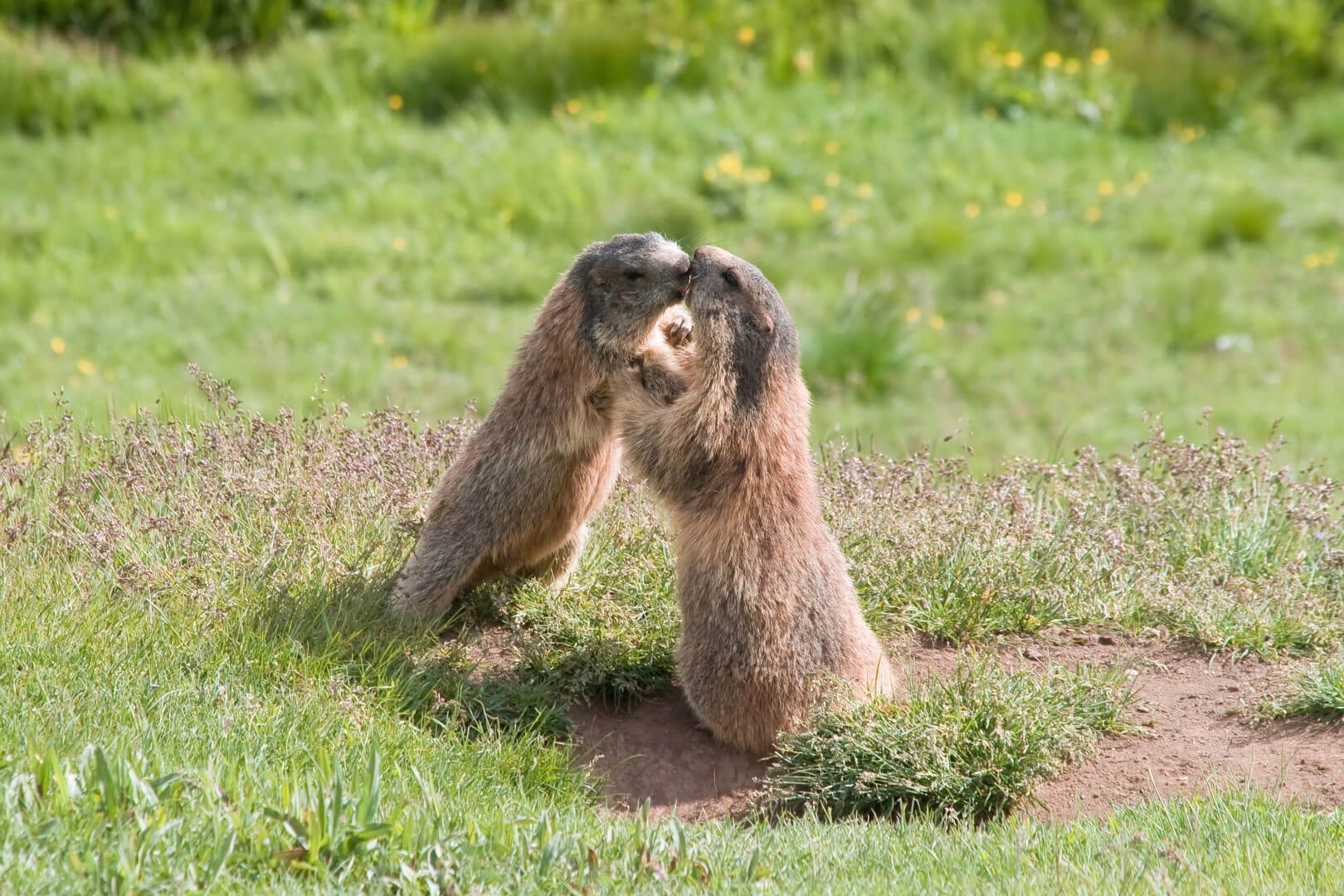
Since 1887, the largest Groundhog Day celebration in the United States has been held in Punxsutawney, Pennsylvania. Over the years, however, Groundhog Day prognosticators have spread across the United States. Groundhog Day here in the great state of New Jersey features our famous woodchucks, Stonewall Jackson III of Space Farms Zoo & Museum, and Milltown Mel II.
It’s true that many New Jerseyans this year are watching out for weather predictions from our celebrity woodchucks – otherwise known as whistle pigs, land beavers, and mouse bears – but how much do folks really know about these special hibernators?
More from Best of NJ
Beemerville Facts
Space Farms Zoo & Museum has been raising groundhogs for over 20 years. According to New Jersey Assemblyman Parker Space, R-24th District, owner of Sussex County’s Space Farms, the real story behind Groundhog Day has little to do with weather prediction: “In nature, Groundhog Day is when the male awakens from his hibernation to find a mate. In reality, he is not coming out to tell us the weather,” he explained.
On the subject of baby groundhogs, Space said that “The groundhog can give birth to up to six kits. When they are born, they are the size of a hamster. The kits have closed eyes and are completely hairless. They stay with the mother for a short time and start to grow pretty quickly.” Stonewall Jackson III, the current Space Farms pick for 2016, was raised from a kit.
Although groundhogs tend to be grouchy when they are awoken from their deep sleep, Assemblyman Space says that they can make good pets. Sharing some care-taking tips, Space mentioned that “Stonewall Jackson III eats a varied diet including grass, corn, pellets, carrots, and leafy items. During the warm season he can pack in over a pound of vegetation for one meal.” When it comes to lifespan, Groundhogs can live to be 10-12 years old.
Milltown Facts
Milltown Mel II is owned by his handler, Jerry Guthlein. Eight years ago, Guthlein decided to have a Groundhog Day celebration in his backyard, and things grew from there. This year’s Mel is the companion of the late Milltown Mel I; Guthlein adopted both Mels from a breeder in Sunbury, Pennsylvania. “You just can’t take a groundhog out of the wild. This gentleman is legally licensed to raise and sell groundhogs. Mel I and II came from the same litter,” Guthlein said. In order to keep groundhogs, owners must have a wildlife captive permit from New Jersey.
“When we got Mel, he was so tiny. He had to be bottle fed for quite a while, three or four times a day. Then he graduated to pellets. Since he is a herbivore, he enjoys eating leaves from cherry trees, vegetables, and dandelion leaves. His has to chew because his teeth are constantly growing, about a sixteenth of an inch each week,” Guthlein explained.
Mel lives in his custom Groundhog Palace in Milltown, which is about the size of a garage. It has all sorts of things to climb and chew on. He also has an igloo that he likes to hide in. “Mel hibernates in the igloo. He packs it full of hay in early November and builds a giant nest. He makes a small hole in the middle of the nest. Then he curls up in a ball.” In the wild, woodchuck burrows can be 8-66 feet long with many chambers and exits.
Hibernation Facts
There is more to hibernation than you might think. According to the National Wildlife Federation, a groundhog’s body adapts for the winter coma. Its body temperature can drop from 99 degrees to an astounding 37 degrees. The heart rate of a hibernating chuck slows from 80 beats per minute to 5BPM. Breathing slows from about 16 breaths per minute to as little as 2. During the 150 days or so of hibernation, the groundhog goes without eating or drinking. Amazingly, it will lose no more than a fourth of its body weight, due to the energy savings from a reduced metabolic rate.
Milltown Mel II is treated like Punxsutawney royalty on Groundhog Day. In fact, Guthlein and his Milltown Wranglers often seem like Milltown’s version of the Inner Circle. “Mel and Phil both come from Pennsylvania. We are a chapter of the Punxsutawney Groundhog Club. We come dressed in our top hats and tails.”
Facts for the Road
With their bushy tails, little legs, beady eyes, and jelly bellies, the groundhog is one of 14 species of marmots. According to National Geographic, they are the largest members of the squirrel family. Groundhogs are extremely clean, and are never bothered by insects or germs. In addition, according to Assemblyman Space, they love to climb pear and apple trees. They also like to pest farmers and find the prime parts of their crops. Groundhogs can’t run very fast when chased, as they only go about 8 miles per hour. While on the run, they can dive into a local water source and swim to their escape. Neatest of all, a groundhog comes with its own alarm system; it can whistle when in danger, or to woo its mate.
Hero (Top) Feature Image: © Antonio Scarpi / Dollar Photo Club