
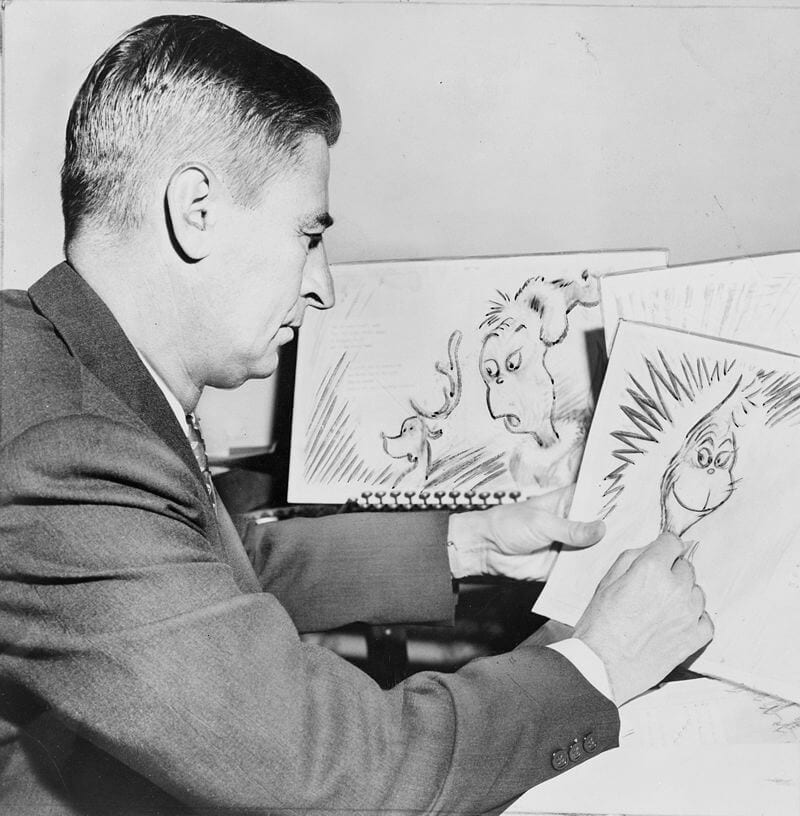
Who could write a children’s book about Hitler or about the environment? Dr. Seuss could. The legendary late author-illustrator (real name: Theodore Geisel) used many of his books to convey messages, at times subtle, as in “Horton Hears a Who!” — and other times, not so not subtle (“The Lorax”). “These books come from the part of my soul that started out to be a teacher,” he said. In honor of Dr. Seuss’s March 2 birthday — honored as Read Across America Day — take a look at some of his beloved books and their deeper origins.
The Butter Battle Book (1984)

The plot: The Yooks butter their bread on the top. The Zooks butter their bread on the bottom. The disagreement over who’s right escalates as each side comes up with bigger and deadlier weapons to attack the other side, leading up to an unresolved cliffhanger ending.
The message: “The Butter Battle Book” is a commentary on the Cold War and the arms race. “‘I’m not anti-military, just anti-crazy,'” director Ron Lamothe recalls Geisel saying in the 2004 documentary The Political Dr. Seuss.
Quote: “The Big War is coming. You’re going to begin it!
And what’s more, this time you are certain to win it.”
Horton Hears a Who! (1954)

The plot: Horton the elephant hears a cry for help from the tiny Whos, living on top of a speck of dust, and tries to protect them even though the rest of the jungle torments him for it, believing the Whos don’t exist.
The message: This classic offers commentary on the U.S. occupation of Japan after World War II (from 1945-1952). “The Whos were the people of Japan, and Ted was saying, ‘You have to listen. A person’s a person no matter how small, no matter what you may think.’ Here Ted was saying, ‘There’s this entire nation that we are in grave danger of overlooking or mistreating because we do not understand them as people,'” said Random House editor Michael Frith, in The Political Dr. Seuss.
Quote: “Should I put this speck down? . . .” Horton thought with alarm.
“If I do, these small persons may come to great harm.”
How the Grinch Stole Christmas! (1957)

The plot: The grouchy Grinch becomes a thieving Santy Claus to stop the Whos’ present-filled Christmas from coming, but fails – and his heart grows three sizes instead.
The message: This holiday classic focuses on the downside of a consumer-focused culture, and the importance of community. “More than a treatise against rampant consumerism, the book promotes inclusiveness – a common theme in Ted’s stories, which often taught children tolerance. The real message of the book involves the true spirit of community, which has been lost” – From “The True Spirit of the Grinch” by Charles D. Cohen, in “Your Favorite Seuss: A Baker’s Dozen by the One and Only Dr. Seuss,” compiled by Janet Schulman and Cathy Goldsmith
Quote: “Maybe Christmas,” he thought, “doesn’t come from a store.
“Maybe Christmas … perhaps … means a little bit more!”
The Lorax (1971)

The plot: The Once-ler explains how he cut down all the Truffula Trees to make his Thneeds, polluting the air and water and chasing away all the creatures who lived there — and the Lorax – in the process.
The message: “The Lorax” is a bit more obvious in its intent, as it clearly supports the environmentalism movement. “Dr. Seuss asks us to speak up for the trees, the water, and the air. If something wrong is being done to the environment, speak up as the Lorax did.” – From “Love It or Lose It” by Pete Seeger, in Your Favorite Seuss”
Quote: “Mister!” he said with a sawdusty sneeze,
“I am the Lorax. I speak for the trees.”
Marvin K. Mooney, Will You Please Go Now! (1972)

The plot: The narrator wants Marvin K. Mooney to leave – by any means necessary.
The message: There might not have been one originally, but one came along later. In 1974, during the Watergate scandal, Seuss sent a copy of the book to newspaper columnist Art Buchwald in which “Marvin K. Mooney” had been crossed out and replaced with “Richard M. Nixon.” Buchwald used the altered version as his column on July 30. (President Nixon resigned on Aug. 9.)
Quote: You can go by foot. You can go by cow.
Marvin K. Mooney, will you please go now!
The Sneetches (1961)

The plot: The Sneetches with stars on their bellies think they’re superior to the Sneetches without stars, until a salesman shows up with a machine that can add stars to Sneetch bellies – or remove them.
The message: Originally “The Sneetches” offered a critique of anti-Semitism, but also of racism. “So brilliantly had Dr. Seuss written this story that, as a child and teenager, I couldn’t even understand how someone could be a bigot. How could anyone dislike someone else simply because of the color of their skin or the shape of their eyes or the country they came from?” Peter Glassman wrote in “He Taught Us How to Think” in “Your Favorite Seuss.”
Quote: But, because they had stars, all the Star-Belly Sneetches
Would brag, “We’re the best kind of Sneetch on the beaches.”
Yertle the Turtle (1958)

The plot: Yertle the Turtle is king of everything he sees — but all he sees is his pond. He forces the other turtles to stack themselves into a throne so he can see even more, and make his kingdom bigger.
The message: Yertle is a metaphor for dictators like Hitler. In a 1987 interview, Seuss said, “Yertle was Hitler or Mussolini. Originally, Yertle had a mustache, but I took it off. I thought it was gilding the lily a bit” – From “Yertle, Hitler, and Dr. Seuss” by Richard H. Minear, author of “Dr. Seuss Goes to War,” in “Your Favorite Seuss”
Quote: “I’m Yertle the Turtle. Oh, marvelous me!
“For I am the ruler of all that I see!”
Hero (Top) Feature Image: Wikimedia
Additional Images (in Order) Courtesy:
The Butter Battle Book/Amazon
Horton Hears a Who!/Amazon
How the Grinch Stole Christmas!/Amazon
The Lorax/Amazon
Marvin K. Mooney Will You Please Go Now!/Amazon
The Sneetches and Other Stories/Amazon
Yertle the Turtle and Other Stories/Amazon