
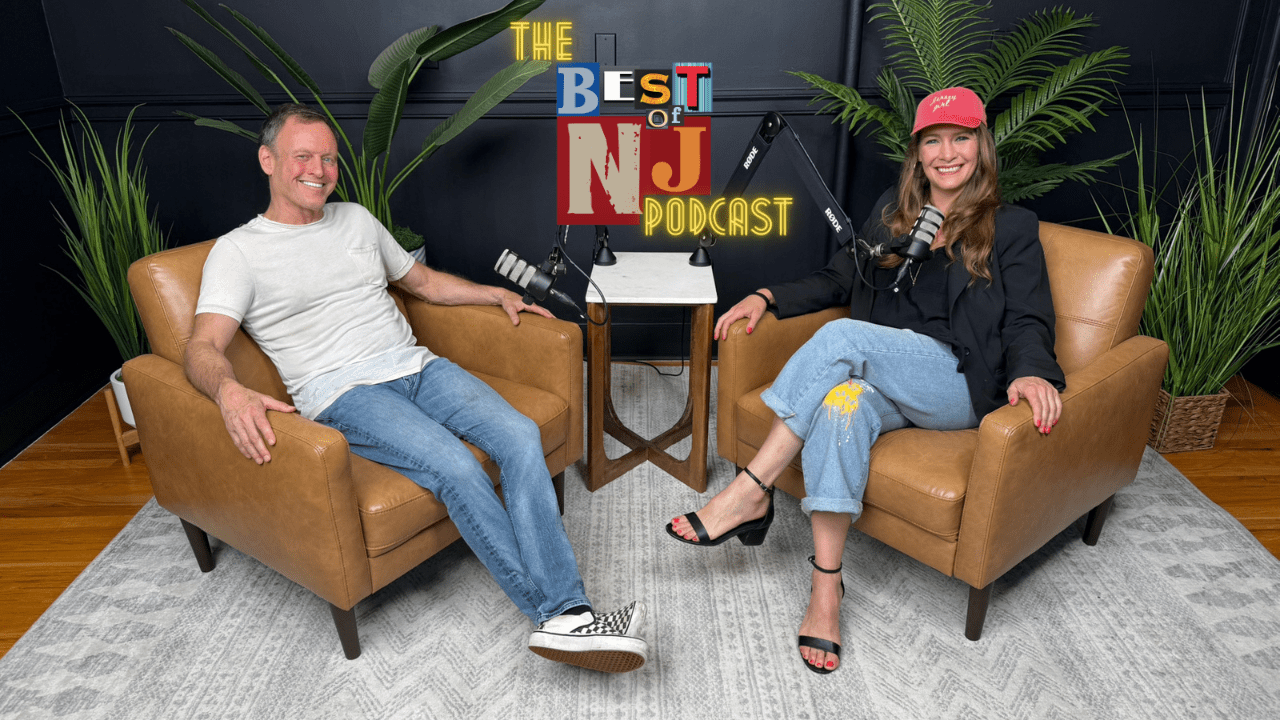
In this Episode of The Best of New Jersey Podcast, host Amanda Morrison sits down with Steve Edwards, President of the New Jersey Hall of Fame. Learn about the Hall of Fame’s museum and learning center at American Dream, the history of the Hall of Fame, recent inductees, and get the inside scoop on an upcoming film about Steve’s family!
Watch The Full Episode Now

Connect with the New Jersey Hall of Fame
Website: https://njhalloffame.org/
Instagram: https://www.instagram.com/newjerseyhalloffame/
Facebook: https://www.facebook.com/NewJerseyHallOfFame
YouTube: https://www.youtube.com/@NewJerseyHallofFame
TikTok: https://www.tiktok.com/@njhalloffame
For More from The Best of New Jersey Podcast:
Follow Amanda on Social Media @DontSitHome
– Instagram: https://instagram.com/dontsithome
– YouTube: https://www.youtube.com/@DontSitHome
– TikTok: https://www.tiktok.com/@dontsithome
Follow the Podcast @bestofnjpodcast
– Instagram: https://www.instagram.com/bestofnjpodcast/
– TikTok: https://www.tiktok.com/@bestofnjpodcast
Keep Up with Best of New Jersey (BestofNJ.com)
– Instagram: https://instagram.com/bestofnj
– Facebook: https://www.facebook.com/bestofnj
– YouTube: http://www.youtube.com/@bestofnewjersey
– TikTok: (https://www.tiktok.com/@bestofnj.com
The Best of New Jersey Podcast Synopsis:
The Best of New Jersey Podcast is a dynamic podcast that celebrates the deep-rooted connection between New Jersey’s most influential figures and the communities that shaped them. Each episode features engaging conversations with high-profile celebrities, executives, athletes, and entertainers. All of whom have lived, worked, or continue to be a part of the Garden State. Through personal stories, nostalgic reflections, and shout-outs to their favorite local businesses, we explore what makes NJ truly special.
More than just a storytelling platform, The Best of New Jersey Podcast is a tribute to the state’s vibrant culture. It spotlights the places, businesses, and experiences that have left a lasting impact on those who call New Jersey home. Our podcast offers an entertaining and insightful look at the personalities and businesses that define the heart of New Jersey. Whether you’re a proud Jersey native, or just curious about what makes this state so unique.
Click to Read Full Transcript
Amanda Morrison: Welcome to the Best of New Jersey podcast. The podcast that talks about influential figures in New Jersey and the communities that shape them. Big names, real talk, real Jersey. This season’s brought to you by bestofnj.com, and I’m your host, Amanda Morrison, the influencer behind Don’t Sit Home. So today, we’re speaking with Steve Edwards, the president of the New Jersey Hall of Fame Museum. Welcome.
Steve Edwards: Are there any influential people here? You said something about influential people. I’m not…
Amanda Morrison: Well, you know a lot of influential people, and I think if you are the president of the museum, you are very influential yourself.
Steve Edwards: I know a lot of influential people. I know people who know people, and yeah, all right. It’s Jersey, baby, okay.
Amanda Morrison: Well, before we talk about all those influential people, give me a little history about the museum. I know you have a new home at American Dream.
Steve Edwards: I am super pleased to tell you about this museum, because it’s as Jersey-centric as it gets. New Jersey state leaders from all walks of life, Democrats, Republicans, all walks of life, north, south, and central New Jersey got together. It took a long time, but last June 2024, New Jersey Hall of Fame opened its permanent museum. It’s literally the first of its kind in the United States of America. I should start by saying there’s only three state Halls of Fame. Really, a fourth one, South Carolina, kind of exists, but not really. So, let’s say four. Forty-six states don’t even have state Halls of Fame. And what’s really cool is New Jersey Hall of Fame really just opened the first state-of-the-art state Hall of Fame museum in the country. I’m just so proud of it and I’m proud of our team and the effort that was made. It is a 10,000 square foot space. It’s at American Dream complex. We call it New Jersey Hall of Fame at American Dream. Of course, American Dream, I’m sure your viewers and listeners know, right next to MetLife Stadium. The museum itself is adjacent to the Nickelodeon Universal Theme Park and the DreamWorks Water Park. So, center of the universe for fun. We’re on the third floor there. It’s a 10,000 square foot state-of-the-art interactive, immersive museum. Twenty-first century, you really want to be interactive and immersive. It’s not the museum of yesteryear, the static objects, you know. And there’s so much to talk about. I mean, I guess I should start off with the signature exhibit right out in front. We have the Model T that Henry Ford gifted to Thomas Edison in 1933. It was on Edison’s property in Fort Myers, Florida, for about a hundred years until it came here to New Jersey. They used to take road trips in this thing, Edison and Henry Ford, and I can’t remember his first name, but Firestone, you know, the tires. Maybe it was Harry Firestone, I’m not sure. But…
Amanda Morrison: How did you get your hands on that?
Steve Edwards: Yeah, how did I get… This wasn’t like a hotwire job. We didn’t do one of that. We didn’t like, you know. We got lucky. The chairman emeritus of New Jersey Hall of Fame is a guy named John Keegan, and John is the CEO of the Thomas Alva Edison Foundation, and he lent it to us. It was not a gift, but it’s been lent to us for many, many years, and it sits there right in the front of our entertainment museum. What’s really cool is right behind it we have a 4D motion ride simulator. We call it the “Fly Me to the Moon, Model T, Fly Me to the Moon Simulator”. So, our patrons can get on and they can experience what it’s like to be an astronaut, taking off into outer space, landing on the moon, re-entry into Earth, landing, of course, on the Jersey Shore, Seaside Heights. Where else would we have this thing land? And that’s narrated by the Kelly brothers.
Amanda Morrison: Oh, very cool.
Steve Edwards: Senator Mark Kelly from Arizona now, and Scott Kelly. They’re from West Orange originally. So anyway, it’s a long-winded answer, you know, but we’re excited about it.
Amanda Morrison: Oh, so if I was going to the museum, what should I expect about the overall experience? So you said it’s an immersive experience.
Steve Edwards: It’s very, it’s very what you should expect. I think first of all, you walk into this place and you really do feel Jersey Pride. If you have any semblance of Jersey pride in your bones, it’s going to hit you like, “Wow, why did this take so long?” Because you start seeing on the walls, the wall of fame, and we have an artist rendering wall. You start seeing Edison and Einstein and Springsteen, Bon Jovi, Tony Morrison, Clara Barton, Harriet Tubman, James Gandolfini, Sinatra. The list goes on and on. And you say, “Wow, man. New Jersey really has exported so much greatness, you know, to the to the world”. And you’re hit, I think, with that Jersey Pride thing when you walk in. But you have all these fun experiences. The Model T, Fly Me to the Moon, was one example. Another one is we have a karaoke stage room so you can get up and you can sing alongside holograms of Gloria Gaynor singing “I Will Survive”. We’ve got Wyclef Jean, “If I Were President”. We’ve got Frankie Valli, “Can’t Take My Eyes Off of You”. Tony Orlando, “Tie a Yellow Ribbon Round the Old Oak Tree”. And you can stand up next to them, sing karaoke with the hologram, and then tape it.
Amanda Morrison: That’s very cool.
Steve Edwards: Should, if you dare to share it.
Amanda Morrison: I wouldn’t want that tape myself. So how long did it take to actually open the museum from the concept starting until today?
Steve Edwards: Fifteen hundred years, from beginning to end. It took a long time. I’m not going to lie. We started on this project. 2004 that we first officially launched the Hall of Fame, and that’s when the legislature said, “Let’s do a Hall of Fame”. I don’t know what happened between 2004 and 2008, but it took us four years to have our first induction ceremony. We were just trying to figure it out in the dark, because nobody had really ever done it at the level Jersey.
Amanda Morrison: Who was the first induction?
Steve Edwards: The first induction was amazing. It’s a memory I’ll never forget. 2008, New Jersey Performing Arts Center in Newark. We had a dramatic lineup at the beginning of the show, and as soon as the light hit the first inductee, General Schwarzkopf was saluting the crowd. I think it went to Tony Morrison next. Yogi Berra, Buzz Aldrin, grandson of Vince Lombardi, Nancy Sinatra representing Frank Sinatra. Bruce, of course, was there at the end. And that was when we were officially born.
Amanda Morrison: Okay.
Steve Edwards: You know, when you have that kind of lineup, it’s hard for people to say, “Ah, that was nothing”. That was pretty, pretty cool moment.
Amanda Morrison: Pretty, a pretty good lineup.
Steve Edwards: Yeah, it sure was. What, so for inductees, obviously we know what that long list of people have done, but what are the criteria for someone to be inducted?
Amanda Morrison: Great question.
Steve Edwards: We got that early on. People were like, “How do you get inducted?” So we have the strictest rule of the three Halls of Fame that I mentioned. It is if you lived at least five years of your life in New Jersey. Doesn’t necessarily mean if you were born here, like Paul Simon was born here, and like they moved literally like three weeks later. He’s not really a Jersey guy. You had to have lived here for at least five years now. Doesn’t mean you have to be born here, though. So Tony Bennett moved here at the height of his career, and he raised his family for 30 years even though he was born in Long Island. That’s a Jersey story. That’s something to to talk about.
Amanda Morrison: Didn’t realize that.
Steve Edwards: So we have that strict criteria. California in contrast, if you lived any portion of your life in California, like you literally could have lived there for a month, and they can induct you. So we felt, you know, to the cynics out there, and we’ve got a few in New Jersey as well, we wanted some strict criteria and that’s what it was.
Amanda Morrison: So who are your most recent inductees? And who is, who do you think, if you’re allowed to say, who’s, who will be coming up soon?
Steve Edwards: Well, we have an induction ceremony, November 21st, Friday, November 21st. Now, since this show is not airing for a little, I will tell you that we’ve got the Isley Brothers. We’ve got Dana Bash from CNN. David Bryan from the keyboardist from Jon Bon Jovi’s band. We’ve got scientists, we’ve got educators. Robert Oppenheimer who developed nuclear technology. The thing about New Jersey is there is no end to the greatness we can pluck. And I say that because a lot of very smart people have been saying for years, “Steve,” when they’re saying it to other board members, “When are you guys, you’re going to run out? Slow down, maybe only do three or five a year”? There are, we have a master list that’s well over 2,000 prominent people from all walks of life. Because remember, we’re not just doing sports and entertainment. We do 15 fields of interest, really, the whole spectrum.
Amanda Morrison: Do you have the same amount of fields of interest that the other museums have? To say that… Do you have the same amount of fields of interest as other museums, or do you have additional categories?
Steve Edwards: I think California does it similar. And I think South Dakota, believe it or not, has the most mature state.
Amanda Morrison: Not what I would think you would say.
Steve Edwards: They started in the in the early ’70s. As a matter of fact, when we started on this project, I flew out to South Dakota, Chamberlain, South Dakota, and I looked to them as a model because they, it was before California. California formed a Hall of Fame right after we launched. New York Times did a story on us and California picked up on it. And yeah, we, it’s all fields of interest. I think that’s important, because most kids are not going to become astronauts or be in the NFL, and if that’s their dream, we want them to go for it, but most aren’t. And so we want to promote all fields of interest.
Amanda Morrison: Do you, are you allowed to say if you have any favorites that have been inducted? Any favorites that have been inducted over the years?
Steve Edwards: Well, Sinatra. I mean, he’s certainly one one favorite. His music is just from another world.
Amanda Morrison: I live in Hoboken, so I can back that up.
Steve Edwards: Yeah. And I used to live there two years ago. I think Tony Orlando who’s, who’s become a good friend of mine, Tony Orlando and Dawn. And he’s one of our inductees. He’s a man with an immense heart. He’s done more work for veterans in this country. He just doesn’t stop. He’s relentless for the past 40 somewhat years, maybe 50 years. He just did a radio show last week on WABC. He’s got Saturday Evenings with Tony Orlando. And he played all this music. You talk about favorites. I mean, Frankie Valli, you know, he played a Frankie Valli song and a Dionne Warwick. And I’m naming music people, of course, but there’s just so many that have been sort of like heroes to me.
Amanda Morrison: Okay. I know you mentioned the induction ceremony. Do you do any other, do you host any other events at the museum?
Steve Edwards: So if you want to operate a successful museum, it’s not a one-day-a-year type of thing. It’s 365 days a year. Not literally, but you always have to have strong, robust programming. So recently we had Tony Orlando Day. He came. There was a few hundred people there. He was singing in our main lobby, “Tie a Yellow Ribbon” to people. They were shocked that he was doing that and singing along with them. He’s had people come up and sing with him with programs like that that are a lot of fun. And people should go to njhallofame.org, or, and they could follow along with our calendar. But we’re literally going to have very exciting programs throughout the year, all four seasons.
Amanda Morrison: So how long have you been associated with the museum? I know it took a long time to get to where you are today.
Steve Edwards: Gray hairs are in my head, and you can answer that question like a piece of, like a tree. Look for the rings, you look for the gray hair. Yeah, I started with a group of other enthusiastic organizers. Bart Oats and Joe Piscopo was right there at the beginning. And George Zoffinger was there, Marvin Schmeltzer. And at the time Governor Codey was governor. He signed it into law. Senator Sarlo, Senator Corrado, Senator Cryan, there was so many people that came together. So I have been with it since the start. And the idea was born in the fall of 2002. So that’s when the idea was born. Nothing happened for a few years. And then nothing happened again. I shouldn’t say nothing happened, but took a while. It was a process. So obviously it took a while to get here, and there is some challenges along the way. Is there any particular part of the museum or anything that you’ve accomplished that you’re the proudest of?
Amanda Morrison: Um, you know, what I would say?
Steve Edwards: Well, first of all, and this is a credit to Governor Murphy and First Lady Tammy Murphy and Turnpike officials and all support. Senator Diegnan was very instrumental. Gary Taffet was very instrumental. The rest stop areas, if you noticed, all the service areas have been renamed after Hall of Fame inductees. So, we’ve created Hard Rock Cafe exhibits almost in each one of them. And at Newark airport, we’ve got all these inspirational posters. We’ll be doing a satellite exhibit in the next year over at the new Terminal A. We’re in New Jersey Transit Station. So I believe it’s like a 100 million people are running into our exhibits, and hopefully seeing the positive, inspirational content that we’re putting out. It’s images of our inductees with these very positive quotes, you know. So that’s something that I know, you know, that I’m proud of that I think a lot of people are proud of. But I’m going to say this, the best part of this initiative, and I think this is true of any nonprofit. I think it’s true in life itself. The interaction you have with people when tell someone tells you, “Wow, you’re making a difference in my life or my child’s life. You made me feel Jersey pride. I didn’t know all these incredible people came from the state. Thank you”. When you get that kind of feedback, that’s the most fulfilling and rewarding part.
Amanda Morrison: Do you think there’s any particular inductee that people are the most surprised that are from New Jersey, or a few people?
Steve Edwards: Well, I think around the country, Edison and Einstein. I think that may be a surprise to some people. Einstein, of course, was from Germany, but he moved to Princeton, and he looked up at the sky in Princeton to figure out a lot of his theories and so forth. People may think he’s from Germany. So that may be a surprise. Honestly, it happens all the time in our museum, and it happened in our mobile museum that we had on the road years ago. The common refrain is, “Who knew”?
Amanda Morrison: Yeah.
Steve Edwards: You know, maybe it’s something in the water or something. There’s something in the water, we know that. I think there’s a lot of surprises. I’ve heard people say, “I didn’t know Jack Nicholson was from New Jersey”. People from Jersey say that.
Amanda Morrison: Even for living in Hoboken, so many people are surprised Frank Sinatra lived there. They always assume it’s from New York.
Steve Edwards: Yeah. And of all the inductees, the ones that don’t surprise people outside of New Jersey and around the world, certainly would be Bon Jovi, Springsteen. Sinatra is not a big surprise to most people. They kind of know he’s a Jersey guy. But many others, yeah, just people don’t realize how many incredible people that have lived here.
Amanda Morrison: So for the museum, we’ve talked about the interactive experience. But do you have any plans other than obviously new inductees coming to the museum, but any plans for even a different exhibit within the museum or?
Steve Edwards: You know, you do have to rotate your content. You got to keep it fresh and relevant. So, we’re always going to be adding. We’re very hologram centric. We’re not about objects. The Model T, of course, is an object. But we have a, for example, a Late Night Jersey Television Studio, a hologram studio, where you can go in and sit down and pretend you’re a talk show host. And you could ask Gloria Gaynor, “How do I reach the pinnacle of the music industry?” You could ask Frankie Valli, “What are you most proud of, Mr. Jersey boy, when it comes to New Jersey?” And we’ve got, I think about 50 different holograms, different, you know, notable people that have participated in those interviews. We’re always going to be adding more interviews. So, you’ll never figure us out. You know, Jonas Brothers will be inducted one day, and they’ll be there, hopefully on our karaoke stage. And young kids can interview them in the Late Night Studio. So, always going to look to add that kind of content.
Amanda Morrison: Okay. So, I heard you produced a film. Would you like to tell me a little bit about that?
Steve Edwards: I did. I appreciate you asking me. It’s near and dear to my heart. It’s a 63-minute documentary feature film, and it’s called Lucky Jack. And it’s a crazy Jersey story about my dad and my mom and my family saga, if you will. We’ve got a hundred reenactment scenes throughout the film. So we, even though it’s a documentary film, we sort of bring it to life. So the story goes that my dad grew up in the Seth Boyden Housing Projects in Newark. Very dysfunctional family. Always wanted to be a doctor, but never applied himself. And in 1954, he was a, went to Weequahic High School. He dropped out. He flunked every course, including gym. I don’t know how you flunked gym.
Amanda Morrison: I didn’t know that was possible.
Steve Edwards: He managed to do it. I mean, how do you do that? And then he was sort of like a Walter Mitty character throughout the ’50s. One failed misadventure to the next to the other. He met my mom in the late ’50s, innocent gal from Brooklyn. And then she moved to Newark. All-American, beautiful woman. And then in 1966, he was 30 years old, high school dropout. He put on, it was the summer of ’66. I want you to imagine this. He had a wife and two children. We were living in Elizabeth, New Jersey. He put on Man of La Mancha’s “Impossible Dream”. He smoked a joint. He put a surgeon smock on, one he drew blood at a local at Barnabas, okay, in Livingston years earlier because he was always hanging around doctors. And he looked in the mirror and he said, “I see,” to himself, “I see a doctor staring back at me”, and not only a general practitioner, a neurosurgeon. It was really good stuff, you know what I mean? But he made this, he had what they call an epiphany. We could all have it without having marijuana and drugs, even though it’s legal now. But he really saw his future. And and that’s the thing about the mirror. If we’re willing to look in the mirror and see not what we want to see, but see what really is, where we are, but imagine where we can go. He really tapped into his imagination. That was the critical thing. He decided, “I’m going to go for it”. He somehow conned my mom into it. And, I’ll make a long story short. Four years later, he graduated from Seton Hall in Newark. He was rejected by every medical school in America. They were laughing at him. So he said, “Okay, I need to go to Mexico”. And somehow he conned my mom into this as well. We went to Mexico for two years. And he finally got into UMDNJ medical school in ’72. He became, he did his residency in neurosurgery. Nine years after that incredible moment, and was operating at Mount Sinai Hospital, okay, on on brains. The really cool thing about all of it is that I was four years old when he had this epiphany, and I got to make rounds with him at Mount Sinai and see this dream come to life. So what’s the story all about? In my view, it is, well, the soul of the film is really the soul of the Hall of Fame. It’s a concept called Arete. Arete is ancient Greek wisdom that Socrates, Aristotle, and Plato all refer to as the essence of life. It means the act of actualizing your highest best sense of self for the greater good.
Amanda Morrison: I love that.
Steve Edwards: Yeah, that was the name of my dad’s boat. And we’re really trying with this film to get messaging across that everyone deep down has an Arete. You just got to dig for it and then you got to believe in yourself. And you got to start taking the small steps and sometimes big steps. The other thing, though, is it, it is not easy. And that is another message we’re trying to get across. I believe the American dream is alive and well 250 years after the Constitution was written. We’re coming up on that birthday next year in 2026. It’s just a messy proposition, and you got to fight for it is the bottom line.
Amanda Morrison: That sounds awesome. So do you, obviously you moved around when you were younger. You live in New Jersey now, obviously. So where do you live in New Jersey?
Steve Edwards: I have a place down in Point Pleasant Park, which is by Bay Head and Long Beach Island. My office is in Woodbridge. I was born same day as Jason Alexander, in Beth Israel Hospital three years later. I told him this when I met him. He’s older than me. Went home to Union, New Jersey, to my grandparents’ house in ’62. We moved to Miami, Florida for a year. Then we came back to Elizabeth when that crazy story started with my dad. And then back to Union is where I spent most of my childhood. And I’m a Jersey guy. I’ve been going to the beach, New Jersey, since 1966.
Amanda Morrison: Do you have any favorite spots in Belmar?
Steve Edwards: Well, they’re no longer there. I wonder why. Let me see. Montego Bay. My buddy Mike Duffy was bartender there. I still train with him once in a while. And Joe McAller from J Empower You.
Amanda Morrison: Do you have any place you miss the most that’s not there?
Steve Edwards: You know what the nice thing about the Jersey Shore is that when you go on the beach, it’s the same as it was 60 years ago when I first started to go there. The ocean still looks the same. The sand pretty much looks the same. So, I’ve become a Long Beach Island guy. But I love the entire Jersey Shore.
Amanda Morrison: Oh, I love it. I used to do a beach house in Ortley Beach for a long time. So…
Steve Edwards: Joey Harrison’s Surf Club and I had an apartment.
Amanda Morrison: Rest in peace.
Steve Edwards: Yeah, yeah. I had an apartment there in 1983. Crazy.
Amanda Morrison: I definitely was at Surf Club a lot. Well, thank you very much for coming to the Best of New Jersey podcast. How can people find out more about the museum?
Steve Edwards: So, they can go to njhallofame.org. We’ve got a website. And you can follow the calendar of events. We’re always going to be having cool people throughout the year, inductees from all walks of life. So, you could always purchase tickets. Very affordable to buy tickets for those events, or on any given day throughout the year. Even if we don’t have an event, people should come over. But yeah, just go to our website, follow the story because it’s your listeners’ and your viewers’ story. It’s them, their Jersey. They really are the inspiration for this museum. And these are their neighbors that are the inductees that are in there. And there’s probably viewers and listeners out there that will be future inductees.
Amanda Morrison: Well, I cannot wait to check it out. And I want to thank everyone for tuning in. You can follow me at @Don’tSitHome on social media and the Best of NJ on social media platforms.
Watch The Latest Episode of The Best of New Jersey Podcast!
Top Photo: © BestofNJ.com